Microsoft continues to improve Copilot Studio at a rapid pace, and the February 2026 update introduces several useful enhancements that make agents smarter, easier to build, and more reliable in enterprise environments. These updates focus on improving how agents work with enterprise data, how prompts are designed, and how AI models can be selected for different scenarios.
One of the key improvements is better responses for ticket-based Microsoft 365 Graph connectors. Agents can now retrieve information more accurately from systems such as ServiceNow tickets and Azure DevOps work items. Instead of simply returning raw data, the agent can generate clear summaries and actionable insights. This means users can quickly understand the status of issues, progress of work items, or pending actions without manually reviewing multiple systems. For organizations using Copilot agents in support or engineering workflows, this can significantly improve productivity and reduce time spent searching for information.
Another interesting addition is the ability to use Claude Sonnet 4.5 (beta) for Computer Use agents. This model is designed to handle more complex tasks and decision-making scenarios. With improved reasoning capabilities, agents can better analyze situations and decide the next step in a workflow. This leads to higher reliability and better success rates for advanced automation scenarios.
Microsoft has also introduced several enhancements to the prompt builder, making it easier for developers and makers to fine-tune how AI behaves.
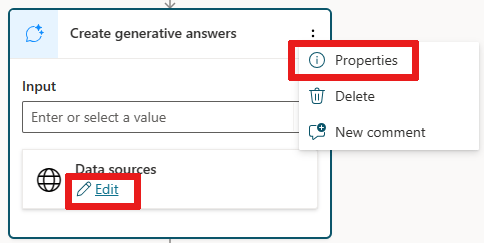
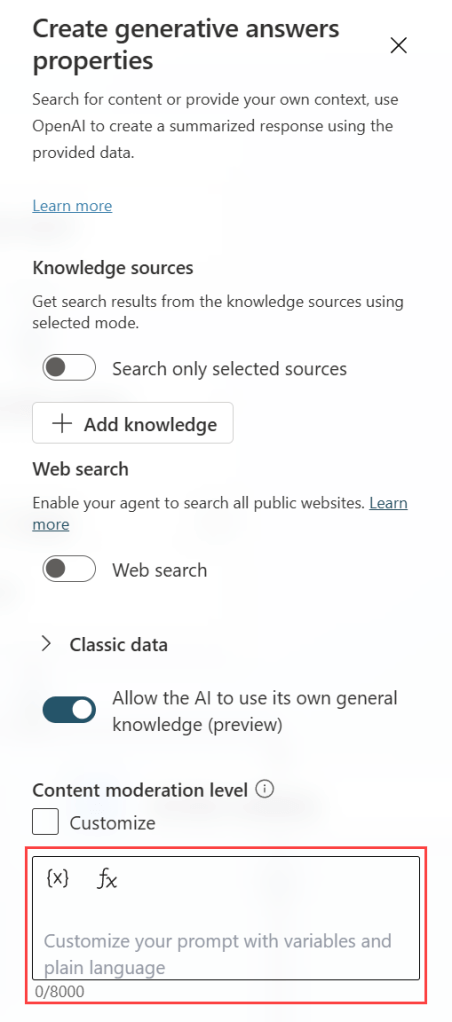
One major improvement is the ability to configure content moderation sensitivity for each prompt. Organizations can now control how the system filters sensitive content such as hate speech, violence, or self-harm. This is particularly useful for companies operating in regulated industries or document-processing scenarios, where the level of moderation may need to be carefully tuned.
The prompt builder also now supports new Claude models such as Claude Opus 4.6 and Claude Sonnet 4.5. These options give makers more flexibility to balance reasoning quality, response speed, and cost depending on the use case. For example, some workflows may require deeper reasoning while others may prioritize speed.
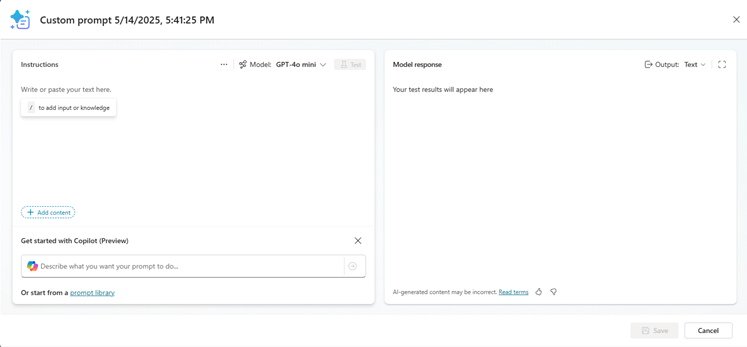
Another usability improvement is the ability to edit prompt instructions and settings directly within the agent tool interface. Model selection, input configuration, knowledge sources, and testing can now be managed from a single place. This simplifies the authoring experience and makes it easier to experiment and refine prompts without jumping between multiple screens.
Overall, the February 2026 update shows Microsoft’s continued focus on making Copilot Studio a powerful platform for building intelligent agents. With better integrations, stronger AI models, and improved prompt management, organizations can build more capable automation solutions while maintaining control over quality and governance.
For developers, consultants, and architects working in the Microsoft ecosystem, these enhancements open up new opportunities to design smarter AI agents that can connect business systems, summarize data, and assist users in real time.
As Copilot Studio continues to evolve, it is becoming an increasingly important tool for bringing AI-powered automation into everyday business processes.
Refer to below links for further deep dives:
https://learn.microsoft.com/en-us/microsoft-copilot-studio/prompt-model-settings
https://learn.microsoft.com/en-us/microsoft-copilot-studio/whats-new
 Brewing thought
Leave a comment