Artificial intelligence is no longer just about a single chatbot answering questions. Modern AI systems can be agents — autonomous programs that take action on your behalf, such as booking trips, querying systems, or gathering data. But as AI agents become more powerful, they also need to work together, just like teams in a company.
That’s where the Agent-to-Agent Protocol (often called A2A) comes in. The A2A Protocol is a standard way for AI agents to communicate and coordinate with one another, even if they were built by different companies or run on different platforms.
Let’s break down what this means, why it matters, where it came from, how Microsoft fits into the picture, and what benefits it brings — all in clear, non-technical language.
The Core Problem A2A Solves
Imagine you have two AI assistants:
- One understands customer service questions
- Another manages finance operations
- A third runs tasks in supply chain systems
Right now, many AI agents work independently. If one assistant needs help from another — for example, a customer request that requires both finance and support actions — they often cannot directly talk to each other.
This limitation creates problems:
- Agents don’t share information easily
- Tasks become fragmented
- Users might need to repeat steps to multiple systems
- Collaboration becomes manual and inefficient
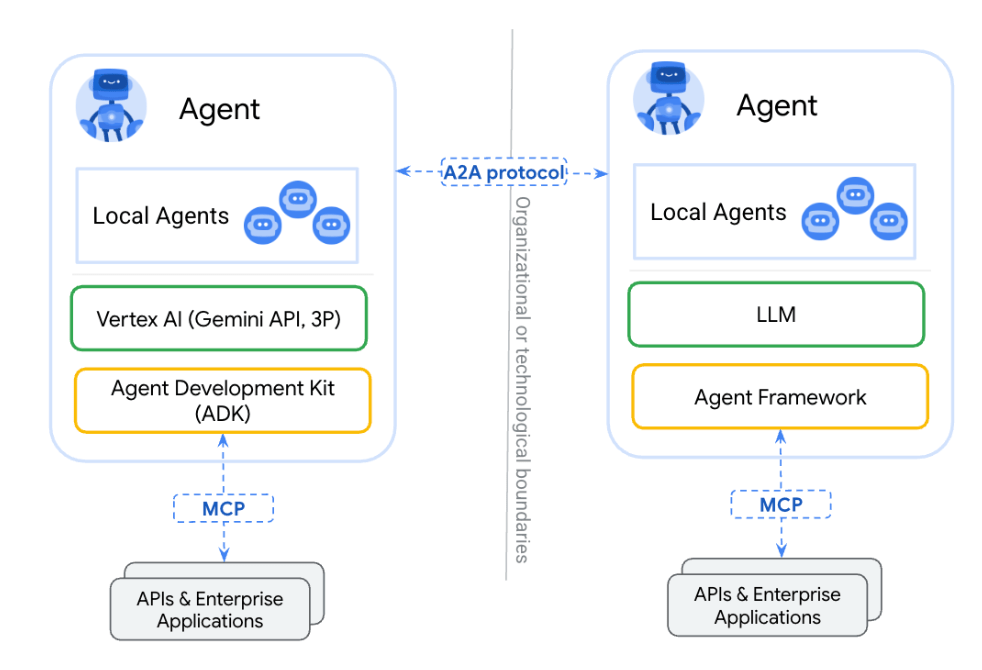
The A2A Protocol enables AI agents to talk to each other in a common, structured way so they can:
- Share tasks
- Exchange data
- Coordinate actions
- Combine their capabilities into a seamless experience
In short, A2A brings collaboration to autonomous AI systems.
What Does “Agent-to-Agent” Really Mean?
Agent-to-Agent Protocol is like giving AI agents a common language and set of rules for communication. Instead of each AI working alone, agents can:
- Discover what other agents can do
- Ask other agents to help with part of a task
- Send results back and forth securely
- Work together on complex workflows
Think of it as turning isolated assistants into a collaborating team, even if they come from different technology providers.
Who Created the A2A Protocol and When?
The Agent-to-Agent Protocol was originally introduced by Google in April 2025 as an open standard to enable interoperable AI agent communication. It was created to allow agents built by different companies or running on different frameworks to reliably and securely talk to one another.
In June 2025, the Linux Foundation officially launched the A2A project to support broad industry participation and open standard development, making it a neutral foundation for multi-agent collaboration.
Although Google initiated the protocol, many major technology companies — including Microsoft — have committed to supporting A2A as part of broader interoperability work for the AI ecosystem.
What Problems A2A Helps Solve
1. Multi-Agent Collaboration
A2A allows one agent to ask another for help, enabling complex jobs to be split across multiple specialized agents.
Example:
One agent identifies a task, another agent executes a part of it, and results are coordinated.
2. Interoperability
Agents built on different stacks — for example, one by a cloud provider and another by a partner company — can still communicate.
This levels the playing field and prevents vendor lock-in.
3. Security and Structure
A2A defines how agents exchange information in a secure and auditable way, similar to how communication protocols like HTTP or SMTP standardize web traffic and email.
4. Reusability and Scale
Companies can build many small, focused agents — each good at one task — and let them work together instead of building one massive “mega-agent.”
This makes systems easier to maintain and upgrade.
How Microsoft Is Embracing A2A
Microsoft is one of the major technology partners that has announced support for the A2A standard. In 2025, Microsoft joined more than 50 technology partners in backing A2A for AI agents.
That means Microsoft is aligning its AI platforms — including Copilot Studio and Azure AI services — with the A2A Protocol so that:
- AI agents built within Microsoft’s ecosystem can communicate with agents built by others
- Enterprise systems can coordinate workflows across agent boundaries
- Copilots and AI solutions become part of an interoperable ecosystem rather than isolated silos
Microsoft’s support for A2A reflects a broader industry trend toward open standards that enable diverse AI agents to interoperate smoothly.
How A2A Works: A Simple Scenario
Let’s illustrate with a simple example:
- A user asks a Copilot: “Prepare a budget summary and then schedule a finance meeting.”
- The Copilot checks the request and determines tasks required.
- One agent specializes in pulling budget data.
- Another agent specializes in calendar scheduling.
- Using A2A, the main Copilot agent asks the budget agent for data.
- The budget agent replies with results.
- Then the main agent asks the scheduling agent to book meetings.
- Both agents collaborate seamlessly and the user gets a unified response.
To the user, it feels like one smart assistant. Behind the scenes, multiple agents communicated and coordinated using the A2A protocol.
Benefits of Agent-to-Agent Protocol
Simpler Collaboration Across AI Systems
A2A allows agents to work together instead of in isolation, making them more powerful as a group.
Better Modularity and Specialization
Instead of creating one giant AI that does everything, organizations can build small specialized agents and let them collaborate.
Faster Innovation
Standards like A2A enable the ecosystem to grow faster because new agents can be plugged into existing workflows without custom connectors.
Vendor-Neutral Communication
A2A helps ensure agents from different companies can communicate, promoting competition, choice, and flexibility.
Enables a Scalable AI Architecture
As organizations scale their use of AI, A2A helps build sustainable systems where agents are responsible for specific tasks and can coordinate efficiently.
Why A2A Matters for the Future of AI
The rise of AI agents is pushing computing toward a future where autonomous systems act on behalf of users and organizations. But without a shared way for agents to communicate, complex automation remains difficult and fragile.
A2A helps lay the foundation for an “agentic internet” — an ecosystem where intelligent agents can reliably collaborate much like the way we depend on shared communication standards like HTTP or SMTP on the web today.
In this future:
- AI agents are not isolated tools
- They discover and call on each other’s capabilities
- They solve complex tasks collaboratively
- Organizations can build ecosystems of specialized, connected agents
Final Thoughts
The Agent-to-Agent Protocol is an important evolution in the AI landscape. Unlike traditional tools or service calls, A2A enables autonomous AI agents to communicate, coordinate tasks, and share information across platforms.
The protocol’s open nature and broad industry support — including Microsoft’s participation — point toward a future where AI systems act as collaborative digital teams rather than isolated assistants.
As AI agents become more common in business and everyday life, standards like A2A will help ensure they can work together in secure, scalable, and meaningful ways.
Official Reference Links for Further Reading
A2A: Agent-to-Agent Protocol Explained (Host Site)
https://a2a-protocol.org/latest/
Linux Foundation Launch of A2A Project
https://www.linuxfoundation.org/press/linux-foundation-launches-the-agent2agent-protocol-project-to-enable-secure-intelligent-communication-between-ai-agents
IBM Think on A2A Protocol Origin and Purpose
https://www.ibm.com/think/topics/agent2agent-protocol
 Brewing thought
Leave a comment